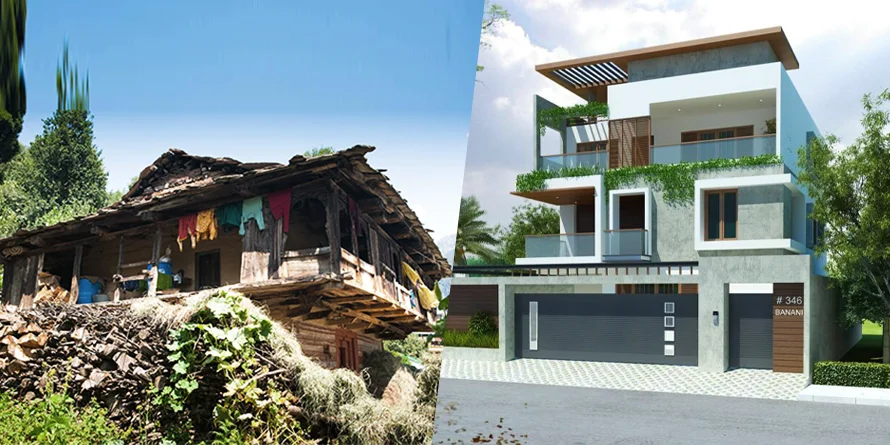
Ever wondered how a humble kutcha house differs from a grand concrete mansion? These two differ not only by architecture but also by lifestyle, resources, and social needs. In rural regions, mud-and-thatch homes serve as affordable, eco-friendly shelters, while urban areas require stronger, more permanent structures built to withstand time and climate.
Understanding these differences is crucial for making smart housing decisions, whether for personal use, development planning, or real estate investment. This blog explores how kutcha and pucca houses vary in materials, cost, durability, and purpose, especially for those evaluating options alongside rising plot rates in Chennai for long-term living.
What is a Kutcha House?
A kutcha house is typically a basic, temporary structure built using local and biodegradable materials such as mud, bamboo, thatch, wooden poles, and even cow dung. A mix of kutcha and pucca houses is especially common in suburban India, while tribal regions, which are prone to natural disasters, have more kutcha houses. Their simplicity allows for swift, low-cost construction and easy repair.
The walls are often packed earth or woven bamboo, while the roofs are made of thatch, tin, or other lightweight materials. Lifespan generally ranges from 5 to 10 years, heavily depending on weather, upkeep, and environmental factors. In places without access to bricks and cement, the kutcha house remains a practical, eco-friendly choice.
Types of kutcha houses include mud huts, bamboo cottages, thatched-roof shelters, and houses made with sticks or cow dung.
Advantages of Kutcha Houses
- Low cost & minimal construction time
- Uses sustainable, local materials
- Easy to repair or rebuild
Disadvantages of Kutcha Houses
- Highly vulnerable to rain, wind, and floods
- Low durability and insulation
- Limited comfort & not suitable for long-term living
Also Read: How to Get a CMDA Completion Certificate for Your Building
What is a Pucca House?
A kutcha house and a pucca house are contrasted in many aspects. A pucca house is a permanent, robust building constructed using modern materials like cement, concrete, bricks, reinforced steel, and iron. Common in urban and suburban India, pucca homes are designed for durability, safety, and comfort.
These houses have solid foundations, brick or concrete walls, and sturdy roofs. Their lifespan can extend well beyond 30 years, provided proper maintenance is in place. With regular insulation, drainage, and modern fittings, pucca houses offer both resilience and convenience. Types of pucca houses include brick houses, concrete apartments, bungalows, villas, and duplex homes.
Advantages of Pucca Houses
- High durability, withstands natural disasters
- Greater resale value and long-term investment
- Provides better insulation and livable comfort
Disadvantages of Pucca Houses
- Higher building and maintenance costs
- Longer construction timeline
- Greater environmental impact due to material usage
Pucca houses are more practical for city life and are now relatively affordable, with the amount of safety and amenities. Reputable developers such as Omshakthy Homes are forerunners in building quality homes that are located in friendly and convenient neighborhoods.
Also Read: How to Apply for a Residential Certificate: Complete Step-by-Step Guide
Key Difference between Kutcha House and Pucca House
Kutcha and Pucca houses represent two ends of the housing scenario, shaped by available resources, location, and purpose. Kutcha houses are made using natural, low-cost materials like mud, bamboo, or thatch, making them easy to construct but less durable. On the other hand, Pucca houses are built with solid materials such as bricks, cement, and steel, offering long-term stability and safety. While Kutcha homes are often seen in rural or disaster-prone regions, Pucca homes dominate urban and semi-urban landscapes. Each serves a specific need—whether it’s affordability and speed or resilience and comfort—making both types vital to India’s housing ecosystem.
Here are the major differences between Pucca house and Kutcha house represented in a table format.
| Feature | Kutcha House | Pucca House |
|---|---|---|
| Material Used | Mud, thatch, bamboo | Cement, bricks, and iron |
| Durability | Short-term | Long-term |
| Cost | Very low | High |
| Construction Time | Days to weeks | Months to years |
| Location Preference | Rural, tribal, remote | Urban, suburban |
| Weather Resistance | Poor | Excellent |
| Resale Value | Low | High |
Also Read: e-Stamp: Application, Verification & Registry Explained
Use Cases: Where & Why Each Type is Preferred
In India, Kutcha and Pucca houses are selected depending on the location, budget, and requirement. Kutcha houses are found in remote or disaster-prone areas since they are less expensive and labor-intensive to build. They consist of local, environment-friendly materials and are appropriate for temporary abodes.
Pucca houses are constructed in urban and semi-urban areas for permanent dwelling, providing strength, security, and increased resale value. With support from programs such as Pradhan Mantri Awas Yojana, Pucca houses are the choice of families needing permanent and secure homes. They all play their role, depending on the climate and way of life.
Kutcha Houses - Differences in Usability
- Temporary emergency shelters: Natural disasters necessitate quick, low-cost temporary shelters.
- Isolated villages: Since no infrastructure is available there, kutcha houses are cost-effective and easy.
- Sustainable construction: Locally produced, biodegradable materials render them low-carbon.
- Flood-exposed areas: Susceptible, but quickly rebuildable following a flood.
Pucca Houses - Differences in Usability
- Urban & suburban houses: Ideal for long-term occupation, with firm foundations and comforts.
- Middle and upper-class mansions: Pucca houses are symbols of status and a sound investment.
- Institutional and commercial buildings: Offices, schools, and shops all depend upon permanent, safe buildings.
- Government housing schemes: PMAY provides subsidized loans and assistance to build pucca houses for lower-income groups.
- Real estate investors: Investors prefer pucca houses for renting and resale, with growing plot rates in Chennai.
Also Read: Non-Encumbrance Certificate: Meaning, Importance and Application Process
Future Trends: Semi-Pucca & Hybrid
Architects and builders experiment with green pucca-type houses constructed using mud-bricks, rammed earth structures, or recycled material to reduce carbon footprints without compromising on durability. The synergy of the kutcha and pucca house concept offers fresh, climate-resilient alternatives, most specifically to the semi-urban and peri-urban areas.
New houses could be constructed using older materials and methods along with newer ones, providing long-lasting, sustainable housing options at reasonable costs without the prohibitively high cost of full pucca construction.
In Conclusion, while a kutcha house offers minimalism, rapid construction, and eco-friendliness, a pucca house offers solidity, safety, and long-term value. Your choice must account for your finances, situation, climate, and duration of stay. For the equilibrium type, the semi-pucca and hybrid houses present a promising middle ground for being ecological and resilient.